

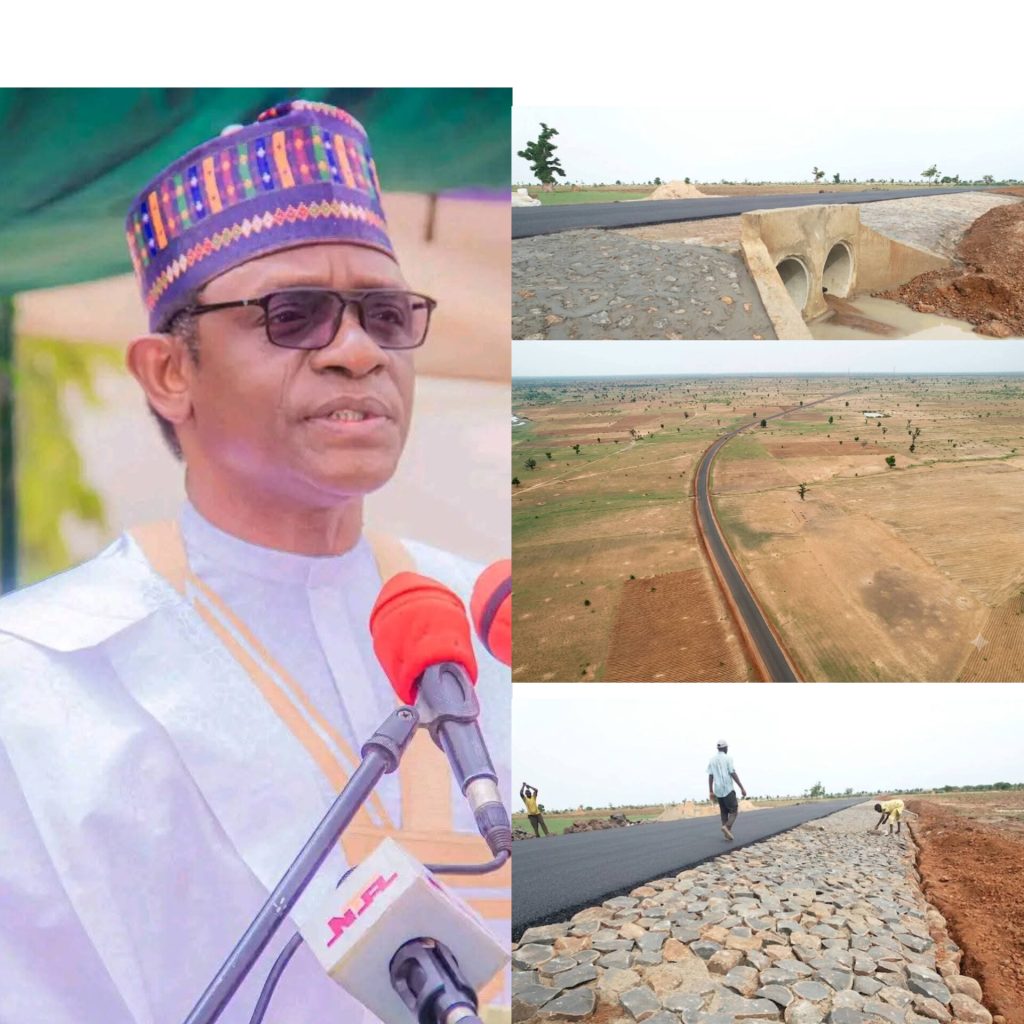
As the administration of Governor Mai Mala Buni approaches its final phase, the tempo of development across Yobe State continues unabated. Rather than slowing down or winding down activities as many outgoing administrations often do, Governor Buni remains firmly focused on delivering projects that directly impact the lives of ordinary citizens.
The latest addition to the state’s growing portfolio of infrastructure is the completion of the 17-kilometre Ngelzarma–Mashio Road, a project that has been widely welcomed by residents, farmers, traders, and commuters who rely on the route for their daily economic and social activities.
The road stands as yet another testament to Governor Buni’s commitment to building critical infrastructure that promotes economic growth, improves connectivity, and enhances the quality of life for the people of Yobe State.
For years, communities along the Ngelzarma–Mashio axis faced transportation challenges that hindered movement, trade, and access to essential services. During the rainy season, travel became difficult, affecting agricultural activities and limiting economic opportunities for residents.
With the completion of the road, those challenges are expected to become a thing of the past. Farmers can now transport produce more efficiently to markets, traders can move goods with reduced transportation costs, and residents can enjoy safer and faster access to healthcare facilities, schools, and other public services.
The project reflects a leadership philosophy that recognizes infrastructure as a catalyst for development rather than merely a construction exercise. By connecting communities and creating easier access to economic centres, the road is expected to stimulate commerce and improve livelihoods across the area.
Governor Buni’s administration has consistently demonstrated a clear vision anchored on purposeful governance, strategic planning, and sustainable development. At a time when many political office holders nearing the end of their tenure begin to scale down activities and focus on post-office engagements, Governor Buni has remained fully engaged in the business of governance. Across the state, construction projects continue, roads are being completed, public institutions are being strengthened, and investments in critical sectors are ongoing.
This dedication has earned him recognition as a leader who understands that governance is a continuous responsibility that should endure until the very last day in office. Indeed, while others may be folding their nets in preparation for exit, Governor Buni remains actively on the field, working tirelessly to improve the welfare of the people who entrusted him with leadership.
The Ngelzarma–Mashio Road is only one among numerous strategic road projects executed under Governor Buni’s administration. Since assuming office, he has pursued one of the most ambitious road infrastructure programmes in the history of Yobe State. Notable among these are the Chumbusko–Tagali Road, Jajimaji–Karasuwa Road, Karasuwa-Galu–Gashua Road, Danchuwa–Garin Bingel Road, Fika–Maluri Road, Nguru–Bulanguwa Road, Gashua–Masaba Road, Bukarti–Toshia Road, and Danchuwa–Jajere Road. These projects, alongside extensive township roads constructed in Damaturu, Potiskum, Gashua, Nguru, Geidam, Buni Yadi, Damagum, Jajimaji, Babban Gida, Fika, and Yunusari, have significantly improved connectivity, boosted commerce, and opened up rural communities to new economic opportunities.
Several roads have been constructed and rehabilitated in urban and rural areas, improving transportation networks and enhancing connectivity between communities. These projects have significantly reduced travel time, facilitated commercial activities, and strengthened links between agricultural production centres and markets.
The administration has particularly prioritised roads that serve farming communities, recognising agriculture as a major pillar of the state’s economy. By providing better access roads, farmers are able to transport produce more efficiently, reducing post-harvest losses and increasing profitability.
Beyond transportation, Governor Buni’s infrastructure drive has complemented investments in education, healthcare, water supply, housing, and security-related facilities. His administration’s approach demonstrates a clear understanding that development is interconnected. Roads facilitate access to schools and hospitals, support business growth, attract investment, and improve overall social welfare.
This integrated approach has contributed significantly to the ongoing transformation of Yobe State, creating opportunities for economic expansion and improving living standards for citizens.
Political leadership is often measured not by promises made but by tangible projects delivered and lives positively impacted. The completion of the Ngelzarma–Mashio Road adds another milestone to Governor Buni’s record of achievement and reinforces his reputation as a leader committed to practical solutions and visible results.
As communities begin to enjoy the benefits of the newly completed road, many observers see the project as part of a broader legacy of infrastructure development that will continue to serve future generations. For residents of Ngelzarma, Mashio, and neighbouring communities, the road is more than asphalt and concrete—it is a pathway to opportunity, growth, and prosperity.
With projects continuing across the state and development efforts showing no signs of slowing down, Governor Mai Mala Buni has once again demonstrated that effective leadership is defined by service, commitment, and the determination to leave behind a better society than the one inherited.
As his administration progresses toward its final chapter, the message remains clear: Governor Buni is not easing off the pedal. While others may be preparing their exit strategies, he remains focused on delivering meaningful development and ensuring that the dividends of democracy reach every corner of Yobe State. The completion of the Ngelzarma–Mashio Road is yet another reminder that his administration remains committed to finishing strong and leaving behind a legacy of progress that will benefit generations of Yobe people.