
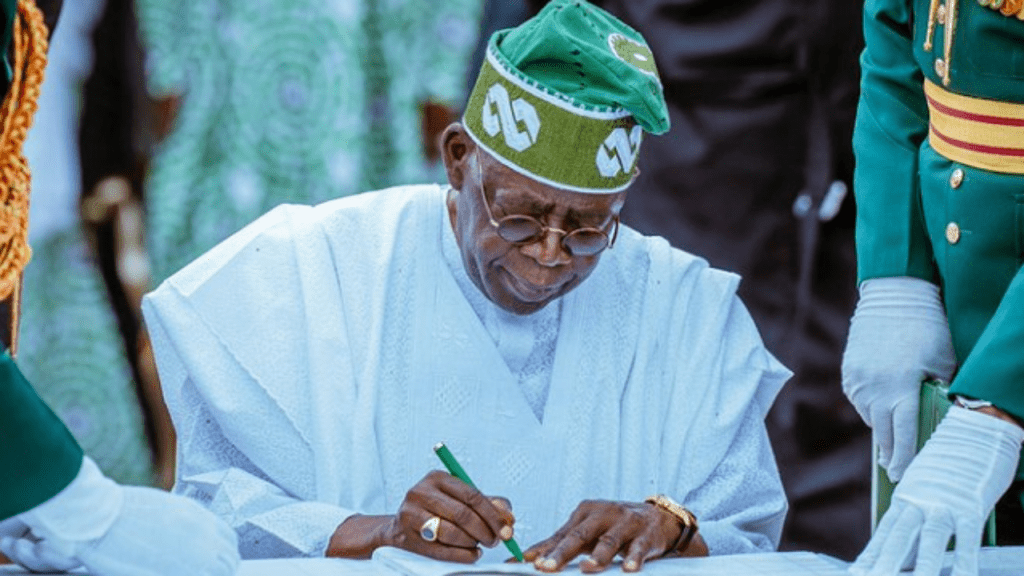
President Bola Tinubu has formally asked the National Assembly to consider and approve the Appropriation (Repeal and Re-enactment) Bill 2 of 2024, proposing a total expenditure of N43.56 trillion for the 2025 financial year.
The request was conveyed through separate letters sent on Wednesday to the Senate and the House of Representatives. In the Senate, the letter was read during plenary by Senate President Godswill Akpabio, while a corresponding communication addressed to the Speaker of the House, Abbas Tajudeen, was presented on the floor of the lower chamber.
In his submission, the President said the proposed legislation was brought in line with constitutional and legislative procedures governing appropriations. He explained that the bill seeks authorisation for the release of N43,561,041,744,507 from the Consolidated Revenue Fund of the Federation for the year ending December 31, 2025.
Tinubu outlined the spending framework to include allocations for statutory transfers, debt servicing, recurrent non-debt expenditure, and capital expenditure alongside development fund contributions. The breakdown provided to lawmakers showed N1.74 trillion earmarked for statutory transfers, N8.27 trillion for debt service, N11.26 trillion for recurrent non-debt expenditure, and N22.28 trillion for capital projects and development funding.
According to the President, the primary objective of the bill is to eliminate the long-standing practice of operating multiple budgets at the same time, while also improving capital budget performance for both the 2024 and 2025 fiscal years. He described the measure as a step toward achieving more efficient and disciplined public finance management.
The proposed law, he said, would also establish a transparent and constitutionally sound framework for consolidating urgent and time-sensitive expenditures, particularly those undertaken in response to emergencies affecting national security and public welfare.
Tinubu further noted that the bill strengthens accountability by ensuring that funds are released strictly for approved purposes, with any adjustments requiring prior approval of the National Assembly. It also provides mechanisms for correcting genuine errors, mandates separate accounting for excess revenue, and enforces compliance with due process and regular reporting obligations by government agencies.
In the Senate, Akpabio confirmed that the President’s request had been forwarded to the appropriate legislative offices for necessary action. In the House of Representatives, Deputy Speaker Benjamin Kalu directed that the bill be taken as a First Reading and scheduled for Second Reading, despite objections from some lawmakers who called for wider circulation of the documents before further consideration. The bill was subsequently referred to the House Committee on Appropriations for detailed scrutiny.
The request comes against the backdrop of concerns over Nigeria’s overlapping fiscal cycles, with multiple budgets often running concurrently due to delays in passage and implementation. The Tinubu administration has argued that repealing and re-enacting the appropriation framework would streamline budgeting, enhance capital project delivery and improve fiscal accountability.
If approved, the proposal is expected to significantly reshape Nigeria’s budgeting process and spark further debate among lawmakers and economic analysts over its long-term implications.