
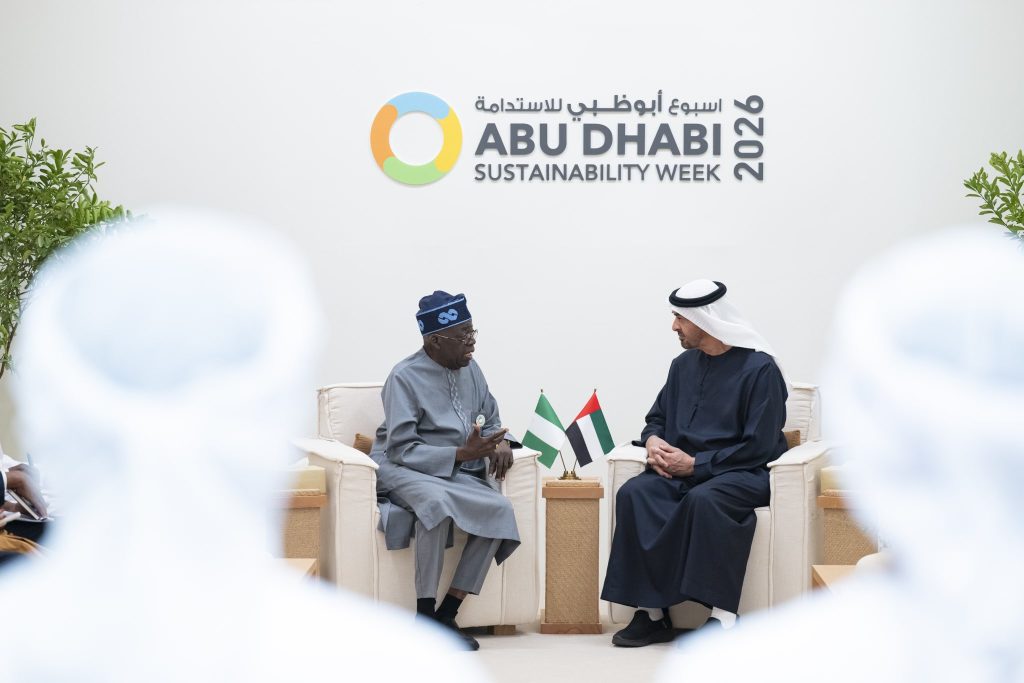
Nigeria and the United Arab Emirates have formalised a Comprehensive Economic Partnership Agreement, opening a new chapter in bilateral trade and investment cooperation between the two countries.
The agreement was signed on the sidelines of the 2026 Abu Dhabi Sustainability Week Summit and is being presented by the Nigerian government as a key pillar of President Bola Tinubu’s Renewed Hope Agenda aimed at expanding trade, attracting investment and creating jobs.
President Tinubu said the pact would significantly improve access for Nigerian goods and services into the UAE market. Under the agreement, the UAE will immediately remove tariffs on more than 7,000 Nigerian products, covering a wide range of agricultural and industrial exports including fish and seafood, cereals, cotton, pharmaceuticals and chemicals.
He added that within the next three to five years, tariffs would also be phased out on Nigerian exports such as machinery, vehicles, electrical equipment, apparel and furniture.
Tinubu said the agreement provides Nigerian businesses with the right to establish corporate entities, branches or subsidiaries in the UAE, while business visitors will be permitted stays of up to 90 days within a 12-month period. Senior executives, managers and specialised staff, he noted, will also be eligible for renewable three-year residence visas.
According to the President, the CEPA removes longstanding barriers to foreign direct investment by giving UAE investors clearer rules and greater confidence to invest in Nigeria’s productive sectors. He said the framework would support industrial growth, improve transport and logistics linkages and generate employment opportunities for young Nigerians.
As part of the deal, Nigeria will remove tariffs on about 6,000 imported items, largely industrial inputs, capital goods and machinery, while retaining its Import Prohibition List. The agreement also liberalises trade in services, covering 99 service areas across 10 sectors, including business, communications, transport, finance, construction, health and tourism.
Nigeria’s Minister of Industry, Trade and Investment, Dr. Jumoke Oduwole, described the pact as a strategic tool for economic transformation, urging local manufacturers to scale up production for export. She said the agreement positions Nigeria as a key entry point for global investors seeking access to the African Continental Free Trade Area, with its market of more than 1.4 billion people.
Oduwole noted that several UAE-based institutional investors, including First Abu Dhabi Bank and Sky Capital, have already shown confidence in Nigeria through investments in major infrastructure projects such as the Lagos–Calabar Coastal Road, as well as deals in agriculture, digital banking, real estate, retail and infrastructure financing.
She said the Ministry of Industry, Trade and Investment, working with agencies such as the Nigerian Customs Service, the Nigerian Export Promotion Council, the Nigerian Investment Promotion Commission and the Standards Organisation of Nigeria, would provide the support and guidance needed for businesses to take full advantage of the agreement.
The minister called on Nigerian private sector operators to actively explore opportunities in the UAE market, stressing that the CEPA was negotiated with their interests in mind.