
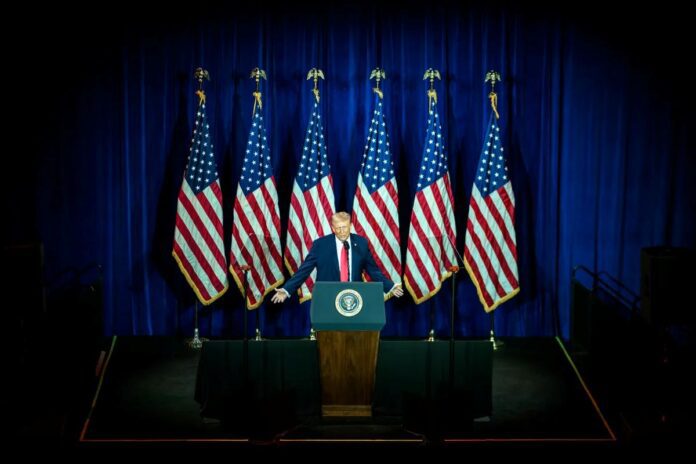
The United States has announced its withdrawal from 66 international organisations, including several climate-focused and United Nations–affiliated bodies, following a directive issued by President Donald Trump.
The decision was outlined in a memorandum signed on Wednesday, covering 35 non-UN organisations and 31 bodies linked to the United Nations system. Among those affected is the United Nations Framework Convention on Climate Change, regarded as the foundational global climate agreement and the framework under which the 2015 Paris Climate Accord was negotiated.
According to the White House, the move reflects a determination that the affected organisations no longer align with American interests and instead promote agendas considered ineffective or hostile to US priorities.
The list of organisations slated for withdrawal includes the 24/7 Carbon-Free Energy Compact, Colombo Plan Council, Commission for Environmental Cooperation, International Development Law Organisation, International Federation of Arts Councils and Culture Agencies, the UN Economic and Social Council’s Economic Commission for Africa, the International Trade Centre, UN Human Settlements Programme, and the Office of the Special Adviser on Africa, among others.
US Secretary of State Marco Rubio said the decision followed an extensive review conducted by the Trump administration into what it described as wasteful and poorly performing international institutions. He explained that the withdrawals were intended to end US funding and participation in bodies seen as advancing global agendas at odds with national interests.
Rubio said the action was carried out in line with Executive Order 14199 signed by President Trump, adding that the review of international organisations is still ongoing. He noted that the affected institutions were found to be redundant, mismanaged, unnecessary, or influenced by interests that conflict with those of the United States.
He further argued that the current global institutional system has strayed from its original purpose, evolving into what he described as an expansive framework of global governance driven by ideology rather than practical cooperation.
According to Rubio, the administration would no longer commit financial resources or diplomatic support to organisations considered incompatible with US sovereignty, economic goals, or policy direction. He stressed that the United States would pursue cooperation only where it directly benefits the American people.
The US government has since released the full list of the 66 international organizations impacted by the decision.