
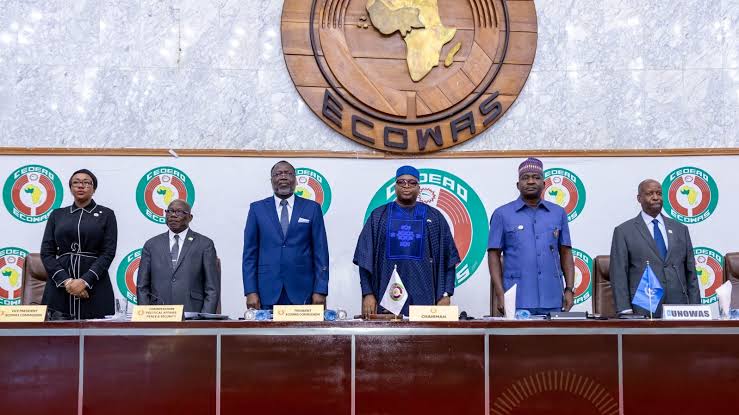
Leaders of the Economic Community of West African States have resolved to adopt a more assertive and coordinated approach to confronting military coups, terrorism and other security threats in the sub-region.
The decision was reached on Sunday in Abuja during the 68th Ordinary Session of the ECOWAS Authority of Heads of State and Government, as the bloc reviewed the growing wave of unconstitutional changes of government and insecurity, particularly in the Sahel. The leaders agreed that the region must move beyond reactive sanctions to proactive military, diplomatic and political engagement.
One of the strongest demonstrations of this new posture, according to speakers at the meeting, was the swift regional response to the attempted coup in the Republic of Benin on December 7, 2025. Within hours of soldiers seizing the state broadcaster in Cotonou, Nigerian fighter jets and ground troops were deployed to back loyalist forces, halting the takeover.
Immediate past chairman of the ECOWAS Authority and President of Nigeria, Bola Tinubu, current chairman and President of Sierra Leone, Julius Maada Bio, and President of the ECOWAS Commission, Omar Touray, all stressed that unity and solidarity were essential to stopping military takeovers and violent extremism in West Africa.
Represented by Vice President Kashim Shettima at the session, themed “Special Debate on the Future of the Community,” President Tinubu identified recurring coups, terrorism, organised crime, arms proliferation, cyber threats, climate shocks, food insecurity and irregular migration as interconnected challenges that no single country could address alone.
He acknowledged that disagreements were inevitable within a regional family but said such differences should not undermine shared values and collective responsibility.
Tinubu warned that external threats facing West Africa demand a common front, noting that insecurity does not respect national borders. He said the region’s stability and prosperity are indivisible and called on member states to act with shared resolve.
The Nigerian leader reaffirmed Nigeria’s commitment to the ideals of ECOWAS, describing regional unity as foundational rather than transactional, and urged that fraternity, not force, should guide the future of the bloc.
He also expressed concern over internal divisions within ECOWAS, saying the erosion of trust among members weakens the entire community. He thanked member states for their efforts in restoring stability and confidence across the region, adding that West Africa’s shared geography should be seen as an opportunity rather than a burden.
In his remarks, ECOWAS Chairman and President of Sierra Leone, Julius Maada Bio, thanked Nigeria for hosting the summit and praised the country’s leadership role in the region. He described the 68th session as a defining moment for ECOWAS and a turning point for more than 400 million West Africans.
President Bio announced that from January 2026, ECOWAS will begin implementing measures aimed at reducing the cost of air travel within the sub-region, including the removal of certain air transport taxes by member states.
President of the ECOWAS Commission, Omar Touray, said recent developments in Guinea-Bissau and the attempted coup in Benin underscored the importance of regional solidarity, commending the swift response led by Nigeria. He noted that for over five decades, ECOWAS leaders have consistently met to address regional challenges through dialogue and cooperation.
Touray also disclosed that business magnate Aliko Dangote has accepted to serve as chairman of the ECOWAS Business Council, which is expected to strengthen engagement between governments and the private sector in driving regional development.
Also speaking at the session, the African Union Commission, represented by its Commissioner for Political Affairs, Peace and Security, Bankole Adeoye, said the meeting provided an opportunity to deepen coordination in promoting democracy and stability. He described the attempted coup in Benin and the instability in Guinea-Bissau as unacceptable and contrary to the African Union’s principles.