
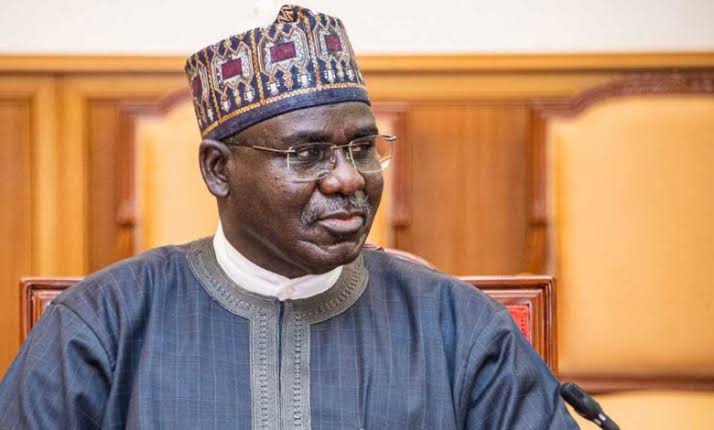
Former Chief of Army Staff, Lt Gen Tukur Buratai (retd.), has cautioned that the growing reliance on soldiers for internal security operations across Nigeria may be undermining the effectiveness of the Nigeria Police Force and other civilian security agencies, despite offering short-term stability.
Buratai made the remarks on Monday while delivering the keynote address at the 2026 Armed Forces Celebration and Remembrance Day lecture in Abuja.
He observed that the widespread deployment of military personnel across the country, including the Federal Capital Territory and all 36 states, has created a situation where civilian-led security institutions are unable to develop the capacity required to effectively manage internal security challenges.
According to him, while military involvement has helped contain immediate threats, it has also fostered a cycle of dependency that weakens the police and internal intelligence services.
“The extensive deployment of the Armed Forces of Nigeria in internal security provides immediate stability, but it also perpetuates a cycle of dependency that weakens civil police capacity and strains defence resources,” Buratai said.
He warned that the trend has resulted in the military being overstretched, with defence funds increasingly channelled into routine policing duties, thereby reducing preparedness for conventional and external threats.
Buratai recalled that the Constitution assigns the Armed Forces of Nigeria the responsibility of defending the country against external aggression, protecting territorial integrity, suppressing insurrection and supporting civil authorities when necessary.
However, he stressed that internal security operations should ordinarily be led by civilian institutions and driven by intelligence, with the police and state security services playing the primary role.
“Internal security, more or less, should be civil-driven and intelligence-driven by the state intelligence services and the police,” he said.
The former army chief warned that prolonged engagement in internal security and developmental roles must not overshadow the military’s core mandate of national defence.
“The Armed Forces of Nigeria remains a vital force for national development and stability, but its expanded internal role must not compromise its primary responsibility or weaken civilian institutions,” he said.
Buratai called for a clear, time-bound and conditions-based exit strategy that would gradually return internal security responsibilities to civilian authorities, while ensuring that the military remains fully prepared for its constitutional duties.
He added that Nigeria’s long-term security and democratic stability depend on building strong, well-equipped and professional police and intelligence agencies, with the military deployed internally only in exceptional circumstances.
Earlier, the Minister of Defence, Gen Christopher Musa, called for a coordinated national effort to disrupt criminal networks that use local transportation systems to move weapons, drugs and other illicit materials across the country.
Musa said tackling the challenge requires the active involvement of local governments, traditional rulers, religious leaders and communities, describing security as a shared responsibility.
“Security is a shared responsibility. Local governments, traditional rulers, religious leaders and communities all have critical roles to play. We must work together to disrupt criminal networks that exploit local transportation systems to move weapons, drugs and illicit materials across our borders,” he said.
The defence minister reaffirmed the Federal Government’s commitment to building a stronger, more professional and self-reliant Nigerian Armed Forces, noting ongoing efforts to improve troop welfare, training, doctrine and indigenous defence production.
According to him, Nigeria has made steady progress in developing locally manufactured defence equipment, reducing dependence on foreign suppliers while strengthening the country’s defence industrial base and creating jobs.
“Our goal is to build sustainable, long-term defence capabilities while reducing reliance on external sources. The revitalisation of indigenous defence industries has gained momentum through policy reforms and legislative support, opening opportunities for private sector participation and innovation,” Musa said.
He added that locally produced defence platforms are increasingly contributing to national and regional security, while also driving industrial growth and economic development.
Musa also commended the Chief of Defence Staff, Service Chiefs and members of the Armed Forces for their professionalism and sacrifices, assuring Nigerians of the military’s resolve to safeguard the country.
“Our Armed Forces have the capacity, the will and the determination to defeat enemies of the state and protect our people,” he said.
The remarks were made against the backdrop of persistent security challenges posed by armed groups, bandits and criminal networks exploiting informal transport routes to move fighters, weapons and illicit goods across states and borders.