
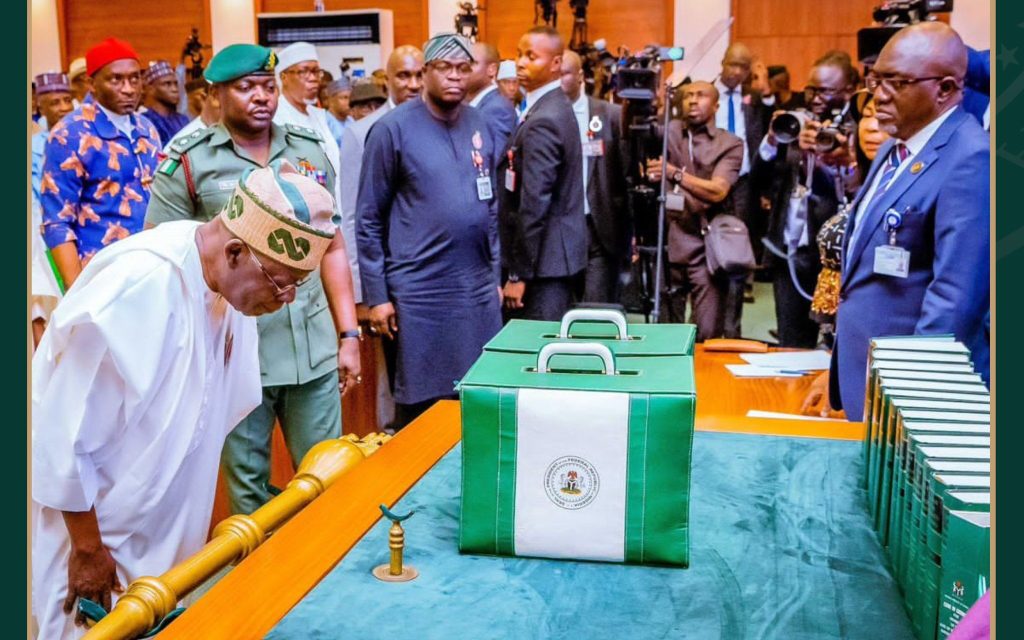
As President Bola Ahmed Tinubu presents the 2026 Appropriation Bill to the National Assembly today, concerns persist over the level of implementation of the 2025 budget, raising questions about transparency and fiscal discipline.
Checks at the Budget Office of the Federation revealed no publicly available record of the 2025 budget performance, despite provisions of the Fiscal Responsibility Act (FRA) requiring regular disclosure. This development has intensified concerns among analysts and stakeholders about accountability in public finance management.
In August, the Director-General of the Budget Office, Dr Tanimu Yakubu, disclosed during a stakeholders’ engagement in Abuja that the Federal Government had been funding the capital component of the 2024 budget with revenues accruing in 2025. He also acknowledged that 2025 revenue projections were underperforming, largely due to Nigeria’s failure to meet its oil production quota.
Efforts to obtain an update yesterday from the spokesperson of the Budget Office, Dr Afolabi Olajuwon, were unsuccessful, as calls and messages were not returned.
The Fiscal Responsibility Act mandates the publication of quarterly budget implementation reports. Section 30 of the Act requires the Minister of Finance, through the Budget Office, to monitor and evaluate budget implementation and publish reports within 30 days after the end of each quarter.
The President is scheduled to present the 2026 budget to a joint session of the National Assembly at 2:00 pm today, according to a notice from the Office of the Clerk to the National Assembly. The proposed 2026 budget is projected at N54.4 trillion, in line with the 2026–2028 Medium-Term Expenditure Framework and Fiscal Strategy Paper.
Ahead of the new budget cycle, the Federal Government has directed ministries, departments and agencies to roll over 70 per cent of their 2025 capital allocations into 2026. A circular issued by the Minister of Budget and Economic Planning, Abubakar Atiku Bagudu, said the rollover must reflect national priorities, including security, the economy, education, health, agriculture, infrastructure, power, and social protection.
The circular also instructed MDAs not to exceed their 2025 overhead ceilings when preparing 2026 submissions, citing revenue constraints despite rising inflationary pressures.
Experts have criticised the current budgeting approach, describing it as confusing and poorly coordinated. A professor of financial economics, Ndubisi Nwokoma, said the proliferation of multiple and overlapping budgets reflects weak governance and poor fiscal planning.
He argued that revenue shortfalls should not justify disorderly budgeting, stressing that unimplemented projects should be properly prorated or deferred within a structured framework rather than rolled over repeatedly.
Similarly, Chief Executive Officer of the Centre for the Promotion of Private Enterprise, Dr Muda Yusuf, called for comprehensive budget reform to end the cycle of rollovers and non-implementation. In a policy brief, he said consolidating outstanding projects and clearing backlogs within a coherent framework would restore credibility to the budget process.
Public finance analysts have also questioned the logic of presenting a new budget without a clear account of the previous year’s performance. One analyst described the situation as “fiscal theatre,” arguing that forward planning without backward accountability undermines confidence in government finances.
The challenge of multiple budgets dates back to the poor performance of the 2024 budget, which was rolled over into 2025 after capital implementation fell short. Official data showed that only about 32 per cent of the 2024 capital allocation was disbursed by the end of the fiscal year.
In an attempt to address the problem, the President has asked the National Assembly to consider a N43.56 trillion Appropriation (Repeal and Re-enactment) Bill for the 2024–2025 fiscal years. In a letter to the legislature dated December 16, 2025, he said the proposal aims to harmonise the two budgets, consolidate emergency expenditures, and reset the federal budgeting framework.
The bill seeks authorisation to issue N43.56 trillion from the Consolidated Revenue Fund for the year ending December 31, 2025, with allocations for statutory transfers, debt service, recurrent expenditure, and capital projects. The Presidency said the move would provide a transparent and constitutionally grounded approach to managing urgent and time-sensitive expenditures while ending the practice of running multiple budgets simultaneously.