
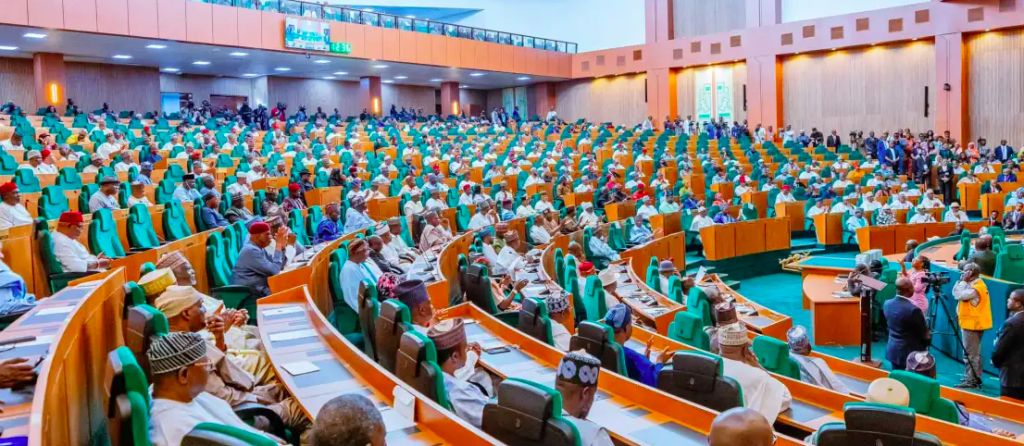
The House of Representatives on Tuesday approved President Bola Tinubu’s request to extend the implementation of the capital component of the 2025 Appropriation Act to March 31, 2026.
The decision followed the adoption of a report by the House Committee on Appropriations during plenary, after lawmakers concluded a clause-by-clause consideration of the revised 2024 and 2025 budget proposals at the Committee of Supply.
The approval came days after President Tinubu forwarded the Appropriation (Repeal and Re-enactment) Bills for the 2024 and 2025 fiscal years to the National Assembly, seeking the repeal of the existing budgets and their replacement with revised spending plans in line with current fiscal realities.
In his letter to the House, the President explained that the revised budgets were based on a 30 per cent capital implementation benchmark, which he said was more realistic given prevailing economic conditions and the government’s implementation capacity. He added that extending the 2025 budget to the first quarter of 2026 would allow ministries, departments and agencies to fully access and utilise approved capital funds.
Revised 2024 budget approved
As part of the exercise, the House passed the revised 2024 Appropriation Act, increasing the total budget size from ₦35.05 trillion to ₦43.56 trillion.
Under the revised framework, ₦1.74 trillion was approved for statutory transfers, ₦8.27 trillion for debt servicing, ₦11.27 trillion for recurrent non-debt expenditure, and ₦22.28 trillion for capital expenditure and contributions to the development fund.
The Act authorises the release of funds from the Consolidated Revenue Fund of the Federation to meet government spending obligations for the fiscal year.
Lawmakers also approved the revised 2025 budget, pegged at ₦48.32 trillion for the period ending March 31, 2026.
The new framework allocates ₦3.64 trillion to statutory transfers, ₦14.31 trillion to debt service, ₦13.58 trillion to recurrent non-debt expenditure, and ₦16.76 trillion to capital expenditure and development fund contributions.
The passage repeals the earlier 2025 Appropriation Act of ₦54.99 trillion, replacing it with a lower expenditure profile.
Committee explanations
Presenting the committee’s report, the Chairman of the House Committee on Appropriations, Abubakar Bichi, said the panel engaged extensively with members of the President’s economic management team to understand the basis for the proposed changes.
He said officials at the meeting included the Minister of Finance, Wale Edun; the Minister of Budget and Economic Planning, Atiku Bagudu; and the Director-General of the Budget Office of the Federation, Tanimu Yakubu.
According to Bichi, the repeal and re-enactment of the 2025 budget were intended to respond to pressing fiscal challenges while preserving legislative oversight and fiscal discipline.
He disclosed that about ₦16.76 trillion originally earmarked for capital projects could not be funded within the initial 2025 implementation timeline and was therefore deferred to the 2026 fiscal year.
Bichi said the adjustment would improve the realism and effectiveness of the budget, reduce governance costs and position the government to take advantage of expected improvements in revenue generation in the next fiscal cycle.
Concerns over overlapping budgets
The committee chairman, however, expressed concern over the practice of overlapping budget cycles, noting that extending the implementation of one budget into another fiscal year could weaken budget clarity and fiscal discipline.
Despite this, he said the committee agreed that current fiscal constraints made the extension unavoidable.
Following deliberations, the House approved the bills clause by clause and passed them for third reading. Lawmakers thereafter adjourned plenary until January 27 for the Christmas and New Year recess.